Gold Medal from Literary Titan

Silver Medal for LGBT Fiction from Global Book Awards

Buy at Bookshop.org and
support local bookstores
The Reviews Are In
Out in Print Review by Keith John Glaeske, June 2024
In 1919, Uchida Kenzo, the illegitimate son of a well-connected Japanese politician, arrives in Stambul to open the new Japanese Consulate. Joining him is Katayama Mitsu, the intelligent and competent son of a poor, but not as well-placed, family. After the Meiji Restoration, Japan is eager to enter the greater world stage, and has jettisoned many of its centuries-old traditions; even so, Kenzo and Mitsu considered themselves practitioners of the ancient tradition of shudō, a sacred intimacy between men of the samurai class. Gül (Kenzo and Mitsu’s Turkish aide from the Consulate), quickly discerns the nature of their bond, and advises Kenzo to acquire a “beard:” a female consort to hide his Gay relationship, and also make him more acceptable to European society. Kenzo subsequently meets Elisa, a Ukrainian refugee, an independent and ambitious woman with knowledge of French and English, who accepts his proposal to act as his consort. The three, together with Gül, travel Europe and eventually end up in Paris, where Mitsu dies from influenza, Kenzo is recalled back to Japan, and Gül and Elisa emigrate to America.
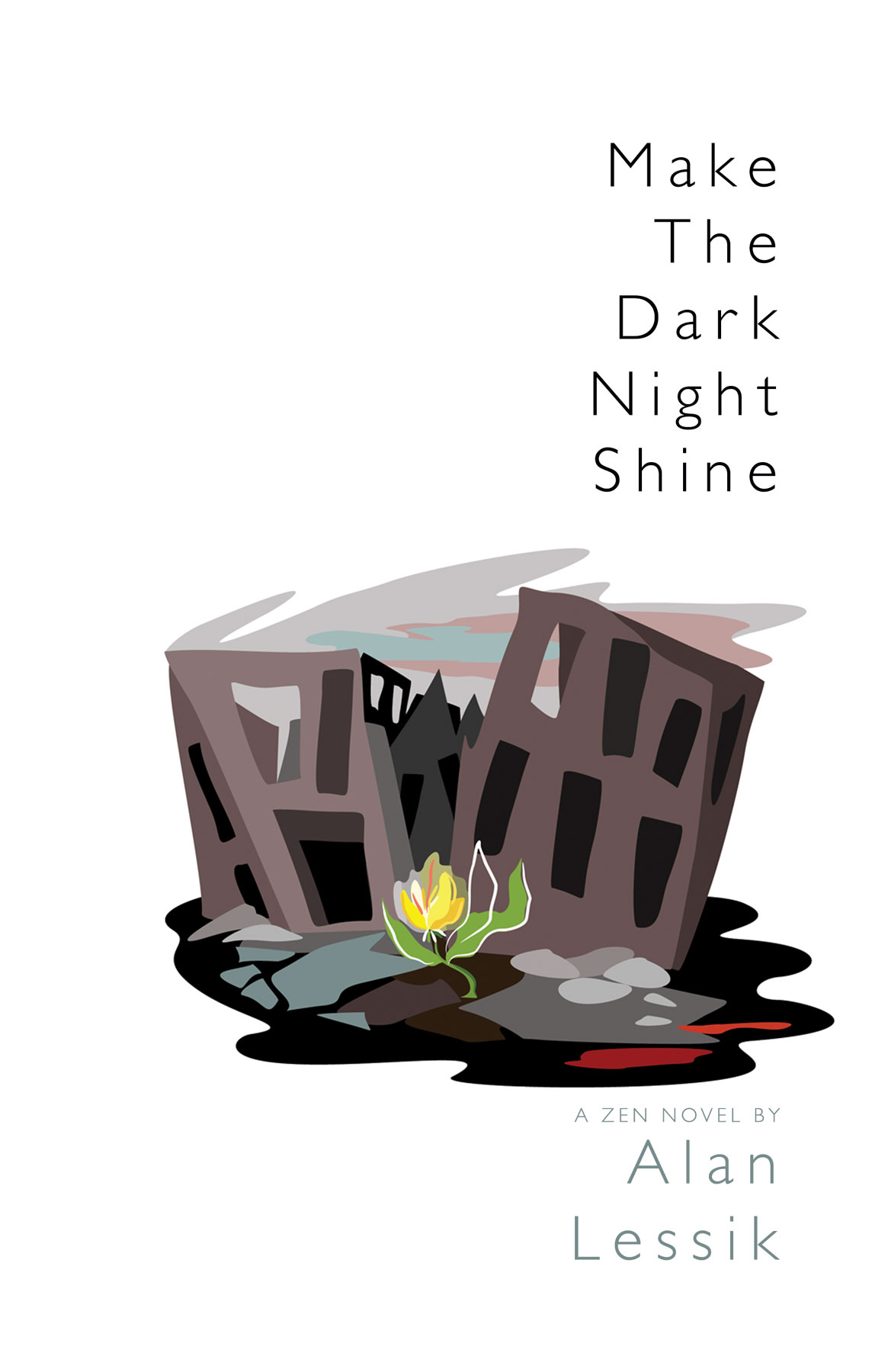
The above synopsis is only the first half of Make the Dark Night Shine: A Zen Novel by Alan Lessik, an exciting compilation of decadent adventure, where Kenzo, Mitsu, and Elisa attend balls and banquets, hear opera, encounter (to them) exotic European religious and cultural traditions, and visit the Gay underworld of metropolitan Europe with Gül. The second half of this novel, after Kenzo returns to Japan, is a completely different journey, foreshadowed by the subtitle: after surviving the Great Kanto Earthquake of 1923, Kenzo starts on the path of Zen Buddhism, eventually being ordained a Zen priest. His pilgrimage is mostly solitary, but along the way he encounters unexpected truths about his own family, not the least that Elisa is the mother of his daughter, a girl named Nina.
A perceptive and sensitive fictional account of the life of a Japanese gay man in the early 20th century. Lessik’s effective use of flashbacks allows Kenzo to tell his story fully, analyzing past events with the wisdom of hindsight as well as offering asides to his daughter. These elements imbue the already lively narrative with a depth of feeling and, often, a sense of poignancy.
Jaidee at Book Sirens, February, 2024
Sometimes a book comes into your life to remind you of your own pathways, your own wisdoms, your own sufferings and the profundities of spiritual living. This is one of those books for me. Reminders and relearning and deepenings.
This is written in a long letter form from a Japanese man to his mixed race daughter in America. A letter so loving and true and bright. An honest and beautiful attempt to heal and love and bring forth wisdoms to a girl that he was not able to nurture in close contact.
We are taken through this man’s life as a diligent student, diplomat in Paris, great love story with his soulmate, reconciliation with family secrets and growth as a Zen Priest and peacemaker. The perspectives are broad, multiple and full of compassion, intrigue and interest. My heart would fill and then empty in tears of both melancholy and joy. Wisdoms are imparted and stirred and reflected. Meetings with Picasso and Stein along with passionate gay love and appreciation of the world of women. Multifaceted like a blemished diamond. Not too bright but extraordinarily wise and beautiful. Psychologically deep and spiritually relevant…I could go on but will leave it here…
Make the Dark Night Shine, by Alan Lessik, is an evocative and intricately woven narrative that transports readers to the shores of Constantinople through the eyes of Kenzo Uchida, a Japanese foreign ambassador. Set against the backdrop of the interwar period, the novel captures Kenzo’s incredible transformation, as he navigates a complex web of love, loss, friendship, and an unexpected career shift. Lessik’s prose is rich and rhythmic, creating an almost lyrical quality that enhances the storytelling.
The novel unfolds as a recollection to Kenzo’s daughter, unknown to him, providing a deeply personal perspective on a turbulent historical era. Characters vividly recount their experiences of the First World War, setting the stage for the impending Second World War. Kenzo, along with his advisor and partner Mitsu, discovers a life starkly different from their homeland upon their arrival in Constantinople. The narrative details their adjustment to foreign customs, aided by their new acquaintances Gul and Elisa, a refugee with aspirations of high society. As the story progresses to Paris and edges closer to another war, the lives of these characters gradually unravel, depicting the subtle yet unstoppable forces of change. The novel explores themes of destiny and decision-making, emphasizing the belief that while we cannot control life’s trajectory, we can have faith in our choices. Family dynamics, both by choice and by bloodline, are central to the narrative, underscoring the interconnectedness of life. Lessik’s novel is a masterful blend of personal journey and historical context while maintaining an uplifting spirit even in its darker moments.
Make the Dark Night Shine is a testament to the resilience of the human spirit, offering a poignant and thoughtful reflection on life’s complexities. Its narrative never feels hurried or overwrought, but rather presents an honest account of one man’s journey through a life marked by both privilege and challenges. This book is a compelling read, offering insights that resonate well beyond its final page.
Michele Cayea, Patchogue-Medford Library, November, 2023
Make the Dark Night Shine by Alan Lessik is a beautiful exploration of the complex themes revolving around family history, personal identity, and the journey toward self-discovery.
The story is a love letter to Nina, the daughter he never met, whose life experiences and family roots become a focal point for the protagonist, as they grapple with their own understanding of self. Lessik took great care with his historical research which serves as a backdrop for exploring familial connections and the impact of heritage on personal growth.
The novel delves into the protagonist’s Kenzo’s spiritual journey, drawing from Zen Buddhism to navigate the challenges and uncertainties he faces. The incorporation of Zen principles offers a philosophical lens through which the characters examine their life, relationships, and inner conflicts, seeking illumination amid darkness.
In addition to these themes, the presence of LGBTQ characters shows a narrative that delves into the complexities of identity and acceptance within familial and societal contexts. The book weaves together these elements—family history, Zen Buddhism, and LGBTQ experiences—to create a narrative that prompts reflection on the interconnectedness of our past, present, and the paths we choose to illuminate our futures.
This compelling read intertwines diverse themes into a thought-provoking exploration of self-discovery and the power of understanding one’s history. Readers looking for a contemplative and multilayered narrative will find Make the Dark Night Shine by Alan Lessik to be an engaging and enriching read.
This is a truly beautiful book, epic and grand in scale. Alan Lessik writes in melodic and lyrical style, telling a sweeping tale of love between the world wars, how ordinary people’s lives were so disrupted by the collapse of relations between nations, and indeed how a peace-loving man finds himself tested at every turn, by global events and tragic ones in his own life.
This is much more than simple LGBT romance, and it would be tremendously unfair to categorize it exclusively as such. Lessik is a truly gifted wordsmith, who has rather composed a historical literary masterpiece. More fascinating is the revelation in the author’s afterword that much of the book is semi-biographical, based loosely on the life of his own Japanese relative. It is well-researched and indeed a labour of genuine love. As his protagonist, Kenzo, travels the world in his diplomatic work in the aftermath of World War One, he still lives by the codes and ways of his own ancestry, the Samurai, taking on a faux-bride to conceal his homosexuality in an increasingly intolerant Western society. We learn a great deal, from Lessik’s effort, about the Samurai and Japanese culture generally, as well as geo-politics and the stuffiness of the civilized world in this period of great hope, yet even greater instability; it appears that none could have foreseen the destruction and disruption to their own lives waiting just around the corner. You feel that perhaps, as the Zen monk he becomes following tragedy in his life, Kenzo is perhaps naïve at times about the further heartache coming his way. And, ultimately, without giving too much away, there is little satisfaction for the reader – of course, by ending the book at a period in time just before we all know how bad things are about to get between the Japanese and Americans, we have to assume there will be no happy ending for Kenzo. In this respect, I think that Lessik has kept his future intentionally ambiguous, and that of his distant daughter, the intended recipient of this journal.
Lessik has created a quite superb book, its vision like broad brush-strokes across the page, yet its detail fine to the point of academia; he knows his subject matter tremendously well, and we the readers are all the better informed for it. I would be very keen to read other work from this author, though I have to be truthful and admit that I am not hopeful it could be as good as this.
James Doig Anderson, Professor Emeritus, Rutgers University, Department of Library & Information Science and contributor to the ALA Rainbow Roundtable, November, 2023
A tender yet horrifying portrait of the 20 years between our world wars through the eyes of a gay Japanese Zen Buddhist monk, via a long letter to his lost daughter Nina. Libraries will especially want to share this moving chronicle of travel to Constantinople with his lover, then Europe and later America because of it’s emphases on multi-cultural and LGBTQ+ issues through historical & family saga fiction.
–
 Alan Lessik